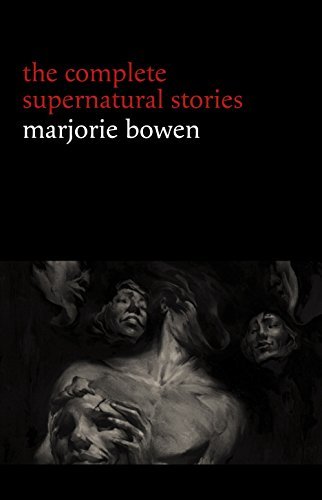
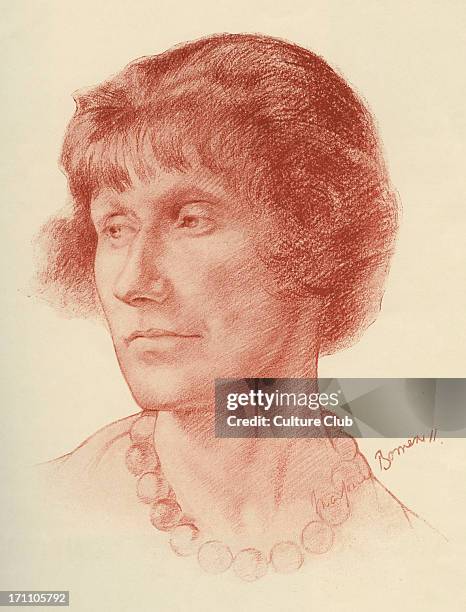
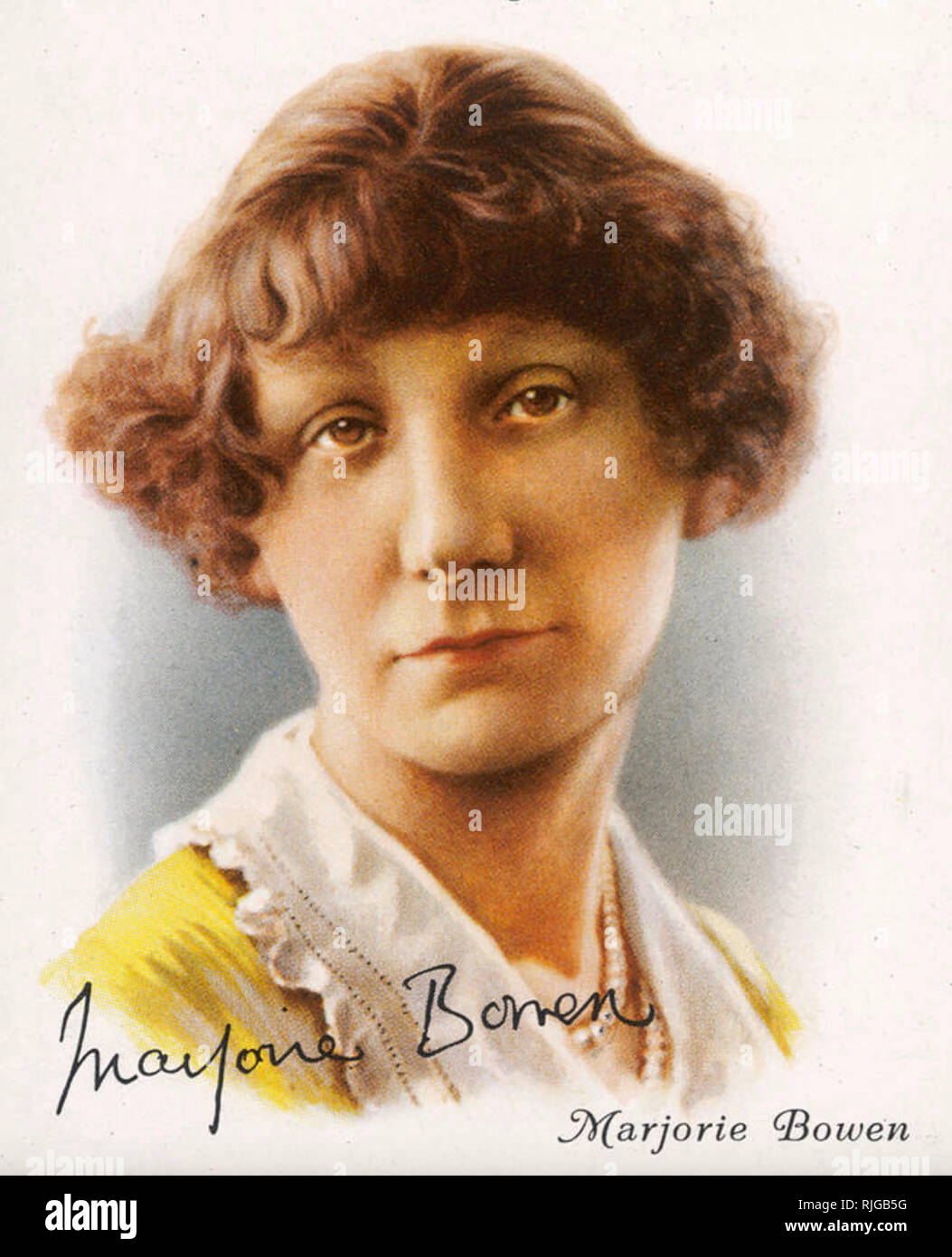
Margaret Gabrielle Vere Long (née Campbell; 1 November 1885 – 23 December 1952), who used the pseudonyms Marjorie Bowen, George R. Preedy, Joseph Shearing, Robert Paye, John Winch, and Margaret Campbell or Mrs. Vere Campbell, was a British author who wrote historical romances and supernatural horror stories, as well as works of popular history and biography.
Life
Bowen was born in 1885 on Hayling Island in Hampshire. Her alcoholic father Vere Douglas Campbell left the family when Bowen was young and was eventually found dead on a London street. She and her sister grew up in poverty, and their mother was reportedly unaffectionate. Bowen studied at the Slade School of Fine Art and later in Paris. At the age of 16, Bowen wrote her first work of fiction, a violent historical novel set in medieval Italy titled The Viper of Milan. The book was rejected by several publishers, who considered it inappropriate for a young woman to have written such a novel. It went on to become a best-seller when eventually published. After this, Bowen's prolific writings were the chief financial support for her family.
She was married twice: first, from 1912 to 1916, to a Sicilian, Zefferino Emilio Constanza, who died of tuberculosis, and then to Arthur L. Long. Bowen had four children; a son and a daughter (who died in infancy) with Constanza, and two sons with Long. Her son with Long, Athelstan Charles Ethelwulf Long, was a colonial administrator.
In 1938, Bowen signed a petition organised by the National Peace Council, calling for an international peace conference in an effort to avert war in Europe.
In an interview for Twentieth Century Authors, she listed her hobbies as "painting, needlework and reading". Her cousin was the artist Nora Molly Campbell (1888–1971). Bowen died on 23 December 1952 at the St Charles Hospital in Kensington, London after suffering serious concussion as a result of a fall in her bedroom.
Work
Bowen wrote more than 150 books, with the majority being published under the pseudonym "Marjorie Bowen". She also wrote under the names Joseph Shearing, George R. Preedy, John Winch, Robert Paye and Margaret Campbell. After publishing The Viper of Milan (1906), she produced a steady stream of writings until her death. Under her own name, Bowen primarily published historical novels, including a trilogy about King William III: I Will Maintain (1910), Defender of the Faith (1911), and God and the King (1911). Her 1909 novel Black Magic is a Gothic horror novel about a medieval witch. Bowen also wrote non-fiction history books aimed at a popular readership.
Under the pseudonym "Joseph Shearing", Bowen wrote several mystery novels inspired by real crimes. For instance, For Her to See (1947, a.k.a. So Evil My Love) is a fictionalised version of the Charles Bravo murder. The Shearing novels were especially popular in the United States, with Moss Rose, The Golden Violet and Forget-Me-Not achieving both critical and commercial success, being championed by reviewers such as Phil Stong. Until the late 1940s, the identity of Shearing was not known to the general public, and some speculated it was the pseudonym of F. Tennyson Jesse.
Under the "George R. Preedy" pseudonym, Bowen wrote two non-supernatural horror novels, Dr. Chaos and The Devil Snar'd. Her last, posthumous, novel was The Man with the Scales (1954), about a man obsessed with revenge, and contains supernatural elements reminiscent of the works of E. T. A. Hoffmann. Many of these stories were published as Berkley Medallion Books. Several of her books were adapted as films.
Bowen's supernatural short fiction was gathered in three collections: The Last Bouquet (1933), The Bishop of Hell (1949) (featuring an introduction by Michael Sadleir) and the posthumous Kecksies, edited for Arkham House in the late 1940s, but not published until 1976.
Critical reception
Bowen's books are much sought after by aficionados of gothic horror and received praise from critics. Graham Greene stated in his Paris Review interview (Autumn 1953), "I chose Marjorie Bowen [as a major influence] because as I have told you, I don't think that the books that one reads as an adult influence one as a writer... But books such as Marjorie Bowen's, read at a young age, do influence one considerably." Horror reviewer Robert Hadji described Bowen as "one of the great supernatural writers of this century". Fritz Leiber referred to "Marjorie Bowen's brilliant Black Magic". Jessica Amanda Salmonson, discussing The Last Bouquet, described Bowen's prose as "stylish and moody, dramatic to the highest degree" and stated "what in other hands is merely tacky or gross is, from Marjorie Bowen, a superior art, chilling and seductive".
Sally Benson in The New Yorker, discussing the "Joseph Shearing" books, wrote, "Mr Shearing is a painstaking researcher, a superb writer, a careful technician, and a master of horror. There is no one else quite like him." Reviewing The Crime of Laura Sarelle Will Cuppy stated, "Those who want a good workout of the more perilous emotions will do well to read Mr. Shearing's impressive tale of love, death and doom.... Join the Shearing cult and meet one of the most malevolent females in song or story." In an article about women writers, the Australian newspaper The Courier-Mail described Bowen as "one of the best of our modern novelists." Sheldon Jaffery stated that Bowen's "weird fiction ranks favorably with such distaff portrayers of the supernatural as Mary Wilkins-Freeman, Edith Wharton and Lady Cynthia Asquith."
By contrast, Colin Wilson criticized Bowen as a writer of "bad adventure stories" in a review of A Sort of Life by Graham Greene.
Adaptations
- Writing as Marjorie Bowen, her 1926 novel Mistress Nell Gwyn was made into a film Nell Gwyn the same year directed by Herbert Wilcox and starring Dorothy Gish and Randle Ayrton.
- Writing as George Preedy, her 1928 novel, General Crack, was adapted as the film General Crack (1930), starring John Barrymore
- Writing as Joseph Shearing, her 1934 novel, Moss Rose, was adapted as the film Moss Rose (1947)
- Writing as Joseph Shearing her 1939 novel, Blanche Fury was adapted as the film Blanche Fury (1948)
- Writing as Marjorie Bowen, her 1943 novel Airing in a Closed Carriage was adapted as the film The Mark of Cain (1947)
- Writing as Joseph Shearing, her 1947 novel So Evil My Love was adapted as the film So Evil My Love (1948)
Works
References
Sources
- Bleiler, Everett (1948). The Checklist of Fantastic Literature. Chicago: Shasta Publishers. p. 57.
- Tuck, Donald H. (1974). The Encyclopedia of Science Fiction and Fantasy. Chicago: Advent. pp. 280–281. ISBN 0-911682-20-1.
Further reading
- Pamela Cleaver, "Bowen, Marjorie" in Lesley Henderson, D. L. Kirkpatrick (eds.) Twentieth-Century Romance and Historical Writers. Chicago: St. James Press, 1990. ISBN 091228997X.
- Edward Wagenknecht, "Marjorie Bowen" in Seven Masters of Supernatural Fiction. New York: Greenwood, 1991. ISBN 0313279608.
- Brian Stableford, "Bowen, Marjorie" in David Pringle (ed), St. James Guide to Horror, Ghost and Gothic Writers. London: St. James Press, 1998, ISBN 1558622063
- William Charlton, "She of Many Names", Wormwood Magazine 9, Autumn 2007
- Mike Barrett, "Dark and Sinister Shades: The Twilight Tales of Marjorie Bowen", The New York Review of Science Fiction July 2010 (No. 263).
- John C. Tibbetts, The Furies of Marjorie Bowen. Jefferson, North Carolina: McFarland & Company, Inc., Publishers, 2019, ISBN 9781476677163. Introduction by Michael Dirda.
External links
- Marjorie Bowen Papers. General Collection, Beinecke Rare Book and Manuscript Library.
- The Life of Marjorie Bowen (archived)
Electronic editions
- Works by Marjorie Bowen at Project Gutenberg
- Works by Marjorie Bowen at Faded Page (Canada)
- Works by Marjorie Bowen at Project Gutenberg Australia
- Works by or about Marjorie Bowen at the Internet Archive
- Works at Open Library
- Works by Marjorie Bowen at LibriVox (public domain audiobooks)